
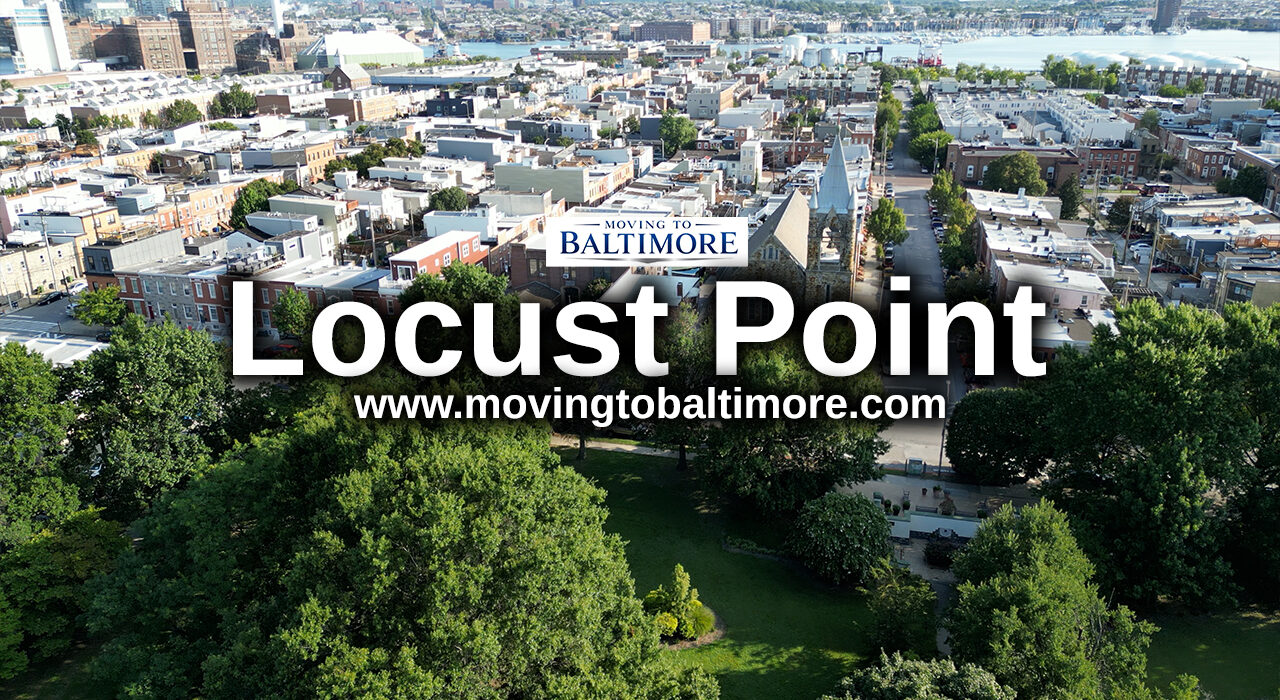
Locust Point sits on a peninsula at the southern end of South Baltimore, surrounded on three sides by the Patapsco River. It is one of Baltimore’s oldest continuously inhabited communities — established as a port of entry by the Maryland Colonial Assembly in 1706 and known historically as “Baltimore’s Ellis Island” because it once served as the third largest point of entry for immigrants to the United States, after Ellis Island and the Port of Philadelphia. Portions of the neighborhood are listed on the National Register of Historic Places, designated in 2012.
The neighborhood’s history is layered and industrial — the Domino Sugar factory, still operating on the waterfront, is a visible reminder that Baltimore’s working port remains an active part of the local economy. That industrial heritage coexists today with renovated rowhouses, luxury condominiums, waterfront parks, and the headquarters of Under Armour, one of the country’s largest athletic apparel companies.
Housing
Locust Point’s housing stock spans nearly two centuries of construction. The oldest homes — two-story rowhouses on Cuba, Clement, and Towson Streets — date to around 1840-1850. Newer construction includes luxury condominiums and high-rise apartment buildings, most notably Silo Point, a converted grain elevator that offers panoramic harbor views. The mix of historic rowhouses and modern residential development creates a range of price points and living options within a compact geographic footprint.
Home prices in Locust Point range from the upper $200,000s for smaller historic rowhouses to the lower $700,000s for larger or updated properties, according to current market data. Owners and renters are roughly evenly split in the neighborhood, reflecting its mix of long-term residents and newer arrivals drawn by the location and amenities.
Fort McHenry
Fort McHenry National Monument and Historic Shrine is the neighborhood’s most significant landmark — and one of the most historically important sites in the United States. During the War of 1812, the fort successfully repelled a British naval assault on Baltimore’s inner harbor in September 1814. The successful defense of the fort inspired Francis Scott Key to write the poem that became the national anthem, The Star-Spangled Banner. The fort is maintained by the National Park Service and is open to visitors year-round, with a mile-long Seawall Trail along the waterfront.
Parks and Outdoor Space
Latrobe Park is the neighborhood’s primary green space, offering baseball and soccer fields, a dog park, and courts for basketball, tennis, and beach volleyball. The Under Armour campus includes a large multi-purpose athletic park available to neighborhood residents. The waterfront location provides access to the Baltimore Water Taxi network, connecting Locust Point to other harbor neighborhoods.
Shopping, Dining and Daily Life
McHenry Row, a mixed-use shopping center within the neighborhood, provides access to grocery, retail, and dining options without leaving Locust Point. The Baltimore Museum of Industry, located on the neighborhood’s waterfront edge, documents the city’s industrial heritage and offers rotating exhibits and community programming.
Restaurants and bars along the neighborhood’s main corridors serve a range of options from casual to full-service dining. The neighborhood’s location — a quarter mile from Interstate 95 — makes regional commuting straightforward, and the water taxi connection to Federal Hill, Inner Harbor, and other waterfront points provides an alternative to driving for daily trips.
Getting Around
Locust Point’s location provides direct access to Interstate 95 via the Fort McHenry Tunnel, making it practical for commuters traveling to Washington D.C., Northern Virginia, or other regional employment centers. The LocalLink and Charm City Circulator bus lines serve the neighborhood along Key Highway and East Fort Avenue. The Locust Point terminal is a stop on the Baltimore Water Taxi’s HarborConnector service. Baltimore/Washington International Airport is approximately 12 miles from the neighborhood.
Housing Options and Buyer Profile
Locust Point draws a mix of buyers and renters — young professionals, families, and long-term residents who value the neighborhood’s compact geography, waterfront proximity, and relative accessibility compared to other South Baltimore neighborhoods. The combination of historic rowhouses at accessible price points and newer luxury condominiums at higher price points gives buyers at different budget levels options within the same neighborhood boundaries.
For buyers relocating from other markets, Locust Point’s location — close to major highways, the harbor, downtown employment, and a nationally significant historic site — offers a distinctive combination of urban convenience and historical character.
Browse current Locust Point listings below, or get in touch and we’ll help you explore what’s available in this neighborhood and nearby.