
There’s a version of Baltimore that shows up in national media — and then there’s Hampden. The two have almost nothing to do with each other. Hampden is quirky, creative, fiercely independent, and deeply proud of being exactly what it is. It’s the kind of neighborhood that doesn’t try to impress you — and ends up being unforgettable because of it.
Located in north-central Baltimore just minutes from Johns Hopkins University, Hampden has evolved from a working-class mill community into one of the city’s most distinctive and sought-after neighborhoods. It attracts artists, young professionals, families, and anyone who values character over conformity — and it does so at price points that remain genuinely accessible compared to Canton or Federal Hill.
A Neighborhood With Roots
Hampden’s story begins with the Jones Falls — the waterway that runs along the neighborhood’s western edge — and the textile mills that lined its banks in the early 1800s. For over a century, Hampden was a mill town, its rowhouses built to house the workers who kept Baltimore’s cotton and grain operations running. When the mills closed in the latter half of the 20th century, the neighborhood fell into decline, as so many American working-class communities did during that era.
What happened next is what makes Hampden’s story worth telling. Beginning in the early 1990s, artists and creative professionals — drawn by cheap rowhouses, a central location, and proximity to Johns Hopkins — began moving in and renovating the 19th century housing stock. The neighborhood reinvented itself organically, block by block, without losing the gritty authenticity that made it interesting in the first place. Today Hampden is frequently cited as one of Baltimore’s best neighborhoods to live in, and home prices have risen accordingly — though it remains more affordable than many comparable urban neighborhoods in the region.
The Avenue
If you want to understand Hampden, start at 36th Street — known universally as The Avenue. This is the neighborhood’s commercial spine and its beating heart: a stretch of independently owned boutiques, vintage clothing shops, record stores, bookstores, coffee shops, and restaurants that has become one of the most distinctive commercial strips in any American city.
Nothing on The Avenue is a chain. Everything has a story. The businesses here reflect the community that built them — creative, local, and fiercely resistant to the kind of corporate homogenization that has hollowed out so many other urban commercial districts. Paulie Gee’s Hampden consistently earns recognition as one of the best pizzas in Baltimore. The Charmery is a beloved local ice cream shop with flavors you won’t find anywhere else. Atomic Books — a neighborhood institution — stocks the kind of eclectic selection that reminds you why independent bookstores matter.
Community, Festivals and Tradition
Hampden takes its community traditions seriously, and two events in particular have become citywide — even nationally recognized — celebrations.
The Hon Fest, held each June on The Avenue, is a tribute to the working women of Baltimore — the “hons” of Baltimore lore — complete with beehive hairdos, cat-eye glasses, and a genuine celebration of Baltimore’s particular brand of working-class pride. It’s charming, self-aware, and entirely unique to this city.
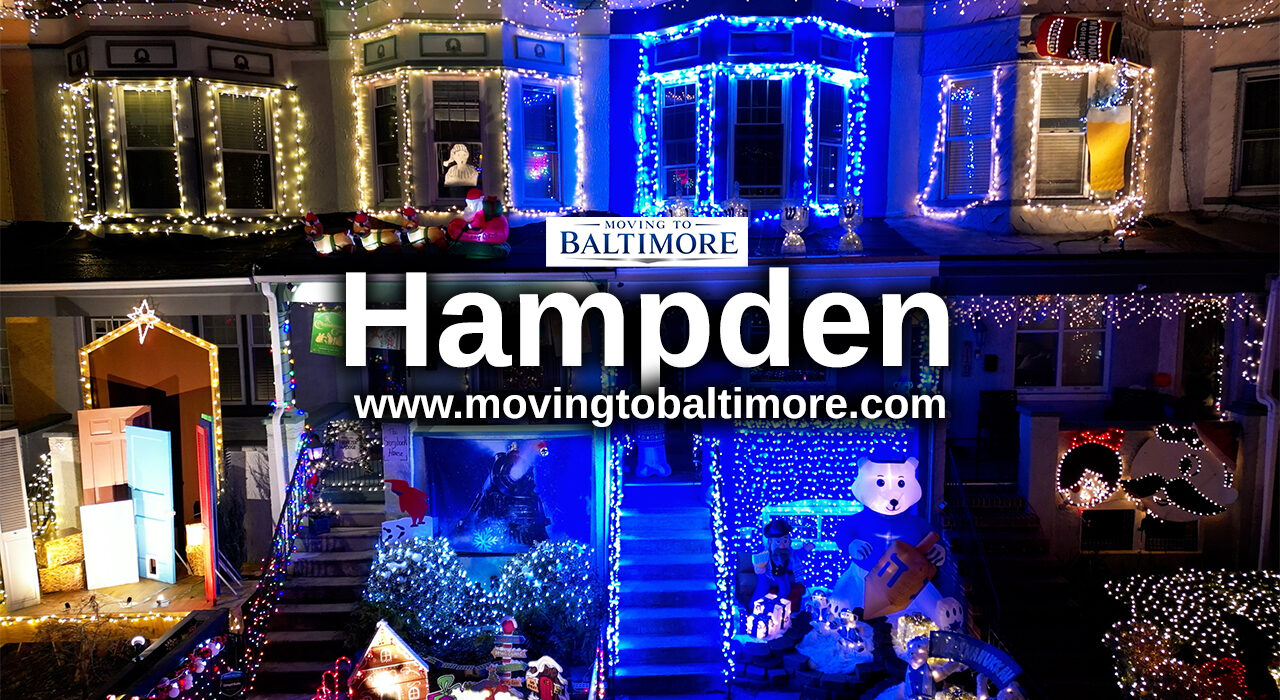
The Miracle on 34th Street is Hampden’s annual holiday lights display, where residents of a single residential block go all out decorating their homes for the Christmas season — thousands of lights, sculptures, and decorations that draw visitors from across the region every December. It has become one of Baltimore’s most beloved traditions, and it happens right here in this neighborhood.
Housing and Affordability
Hampden’s housing stock is primarily small brick and stone rowhouses built in the late 19th and early 20th centuries for mill workers — compact, characterful, and increasingly renovated to modern standards while preserving their original detail. Prices average around $325,000 for rowhouses, making Hampden one of the most accessible entry points into Baltimore’s desirable north-central neighborhoods.
Owners slightly outnumber renters, giving the neighborhood a stable, invested-resident base that contributes to its strong community culture. The mix of long-term residents and newer arrivals creates a genuinely diverse social fabric — one of Hampden’s most cited strengths by people who live there.
Getting Around
Hampden sits directly alongside Interstate 83, which provides fast, direct access to downtown Baltimore (about 10 minutes by car) and continues south toward the Inner Harbor. The Light Rail runs nearby, and the neighborhood’s Walk Score reflects its genuine walkability — daily errands, dining, and shopping are all achievable on foot for most residents.
Johns Hopkins University’s Homewood campus is a short distance to the east, making Hampden a natural choice for faculty, graduate students, and university-affiliated professionals. The up-and-coming neighborhoods of Remington (to the south) and Woodberry (to the west) border Hampden directly, and the broader corridor from Hampden through Charles Village to Johns Hopkins has become one of the most creatively energetic parts of the city.
Who Hampden Is Right For
Hampden attracts buyers who want urban energy without urban prices — people who value independent businesses over chains, character over polish, and community over anonymity. It’s a natural fit for first-time buyers, creative professionals, academics, and anyone who wants to plant roots in a neighborhood that has genuine momentum without having already priced out the people who made it interesting.
For buyers relocating from Washington D.C. or other high-cost markets, Hampden often reads as an extraordinary value — the kind of neighborhood that would cost two or three times as much in any comparable East Coast city.
If you’re looking for somewhere that feels alive, looks like nowhere else, and still has room to grow — Hampden deserves a serious look.
Ready to see what’s available? Browse current Hampden listings below, or get in touch and we’ll help you find your place on The Avenue.